The brick didn't just employ Mount Union — it built the town, brick by brick, and gave it a name known across the industry. Much of the detail below on the industry's founding decade comes from Charles Howard Welch's 1909-1910 History of Mount Union, Shirleysburg and Shirley Township, shared with this project in 2026.
Silica Brick, World-Famous
Beginning around 1899, Mount Union's mills processed ganister — a quartz-rich sandstone quarried from Jacks Mountain — into silica (refractory) brick prized for lining the furnaces of the steel, iron, glass, and railroad industries nationwide. At its peak, three plants employed roughly 2,000 people and turned out an estimated 500,000 bricks a day, making Mount Union the world's largest producer of refractory material of its kind.
Built By the Workers Themselves
Before 1936, quarrymen walked three miles to the base of Jacks Mountain and then scrambled up steep, dangerous inclines — some hitching risky rides on dump cars, a practice that cost at least two workers their lives. When the St. Patrick's Day Flood washed out the mine-cart bridge, the company put its idled workforce to building a stairway up the mountain instead of laying them off. The result: roughly 1,050 hand-built stone steps, climbed daily by six-day-a-week laborers headed to bust rock with sledgehammers. The Thousand Steps still stand today as part of the Standing Stone Trail — equal parts hiking landmark and monument to the people who built it.
A Working Town
Refractory brick was the headline industry, but Mount Union's economy also ran on tanneries, coal yards, an explosives plant, foundries, and the East Broad Top narrow-gauge railroad, which hauled goods through the valley until the mid-1950s.
Bricktown Museum
Located at 300 W. Small Street, the Bricktown Museum keeps the story of the refractory era alive for residents and visitors alike — a natural next stop for anyone who wants to see (and touch) the history behind the name.
Happening Now: The Pennsylvania Avenue & Linear Park Project
The East Broad Top's old right-of-way is getting a second life. A streetscape and linear-park project, spanning three blocks of Pennsylvania Avenue between Jefferson, Division, and Franklin Streets, aims to implement goals from the Borough's 1989 Development Strategies Plan: safe pedestrian and cyclist crossings, curb cuts, lighting, and a connection to the wider Juniata River Trail and Raystown Lake recreation area. The East Broad Top Railroad Preservation Association — the non-profit that owns and is “currently refurbishing the tracks to accept freight and tourism trains” — has already built a walking path along the corridor; the Borough is now working on the street-crossing pieces to connect it safely, alongside a separate reconstruction of a retaining wall whose earlier failure closed a Borough road for an extended period. Planet Love Joy, a community action group, is handling tree planting and beautification. The effort is part of the Juniata River Blueprint Communities initiative, which also spans Mapleton Borough and Shirley Township (see the Historic Walking Tours on the Calendar page, hosted with the same partnership).
Sources: Mount Union Borough, “Pennsylvania Avenue Project” (mountunionpa.net); Juniata River Blueprint Communities, “Pa Ave Wall/Linear Park Project” (jrblueprint.org). Neither source gives a project timeline, budget, or completion date.
The Three Brick Giants
Three companies, all drawing on the same Jacks Mountain ganister, built Mount Union's reputation as the world's refractory capital — two founded almost simultaneously at the turn of the century, the third a decade later.
Harbison-Walker Refractories
Started as the W. H. Haws Co. plant in late 1899, sold within the year to the Harbison-Walker Company of Pittsburgh. Raw ganister came down from atop the mountain by incline cable. By 1909-10 the works ran 29 kilns (each holding about 90,000 brick), had its own electric plant, and employed over 600 men producing 140,000 brick a day — part of a 32-plant national company (Welch 1909-1910, printed pp. 342–349).
Mount Union Silica Brick Co.
Founded by Scott Dibert of Johnstown, a pioneer of brick-making in the area; the works made their first brick on November 27, 1901. By 1909-10 the plant ran 18 kilns and was approaching 80,000 brick a day, drawing on ganister reserves along ten miles of Tuscarora Mountain plus holdings on Stone Mountain and Jacks Mountain — reserves Welch says were “enough to last at least 100 years” (Welch 1909-1910, printed pp. 383–389). General Refractories Co. bought the plant in 1915, eventually operating 41 company houses for its workforce — including the roughly 100-house Ganister Hill community, demolished in the early 1950s — before permanently closing in 1959 (Mount Union Historic District, NRHP nomination, 1994).
Mount Union Refractories Co. — the Third Plant
A second Harbison-Walker works (No. 2) was added 1903-04, but the town's third major plant was Mount Union Refractories Co., organized 1911-12. It became U.S. Refractories in 1922, merged into North American Refractories in 1930, and eventually closed (Mount Union Historic District, NRHP nomination, 1994). Together, these plants and their predecessors are the “three plants” behind Mount Union's peak refractory-era employment.
Beyond Brick: Tanneries, Banks & Power
Brick was the headline, but it wasn't the whole economy. Welch's 1909-1910 industries chapter documents a much fuller working town.
Mount Union Tanning Co.
Traces to John Bare's first tannery, through Faust family ownership from 1874, to a modern (1909-10) capacity of 250 hides a day, importing hides from South America, China, and British East Africa (Welch 1909-1910, printed pp. 361–370). Even Africa's own 1883 book can't settle the founding date: one passage puts the first tannery at 1850 and the second at 1860; a second passage — inside Richard J. Faust's own biography — puts them at 1859 and 1869 instead, with different production figures attached to each account (Africa 1883, PDF scan p. 435). Rather than pick one, both are preserved here as the genuine, unreconciled discrepancy they are.
Juniata Oak Extract Co.
Extracted tannin from chestnut wood, oak, and hemlock bark for the tanning trade, shipping concentrated tannin nationwide — and as far as South Africa and Australia — in its own tank cars (Welch 1909-1910, printed pp. 370–379).
Central Banking Company & First National Bank
The Central Banking Company survived the financial panics of 1873, 1893, and 1907, and trained tellers who went on to lead banks across the region. The First National Bank opened in 1902 and moved into its own building in 1909 (Welch 1909-1910, printed pp. 307–323). It was organized March 13, 1873 with Thomas H. Adams as president and E.S. Doty as cashier, at the corner of Water and Division Streets (Africa 1883, PDF scan p. 441) — and later occupied its own building at 111 N. Jefferson St. (1902), then a third, Italian Renaissance Revival building as the Penn Central National Bank (1916) (Mount Union Historic District, NRHP nomination, 1994).
Mount Union Water Co. & Light & Power Co.
The water works, after a false start in 1883 and a stalled 1899 franchise, finally reached town in 1900. Electric current followed on August 20, 1905 — the town's first night with electric streetlights (Welch 1909-1910, printed pp. 389–396).
Rummel's Mill & Ewing's Mill
Two long-running mills at the corner of Washington and Water Streets and elsewhere in town, feeding the community through multiple owners across the late 1800s and early 1900s (Welch 1909-1910, printed pp. 339–340, 356–357).
Bottling Works, Chair Factory & Shirt Factory
The Mount Union Bottling Works (founded 1908 by the Faust family), a Chair Factory built from a former tannery building, and the Mount Union Shirt Factory (35 women workers, 90–100 dozen shirts a day) rounded out the town's manufacturing base (Welch 1909-1910, printed pp. 353, 380, 396). A submitted photograph, captioned in-frame, gives this Chair Factory a name Welch's text never does: the Defrehn Chair Company — see the photo below and the Gallery.
Etna Explosives Co.
A federal wartime munitions plant that, along with the refractory works, drew a wave of new residents to town during World War I — part of a broader shift from the largely homogeneous, Protestant Mount Union of before the war (Mount Union Historic District, NRHP nomination, 1994). See History for more on this era's population growth and social change.
The Defrehn Chair Company
Previously just “a Chair Factory built from a former tannery building” in Welch's account — a submitted photo puts a name and a face on the building itself.
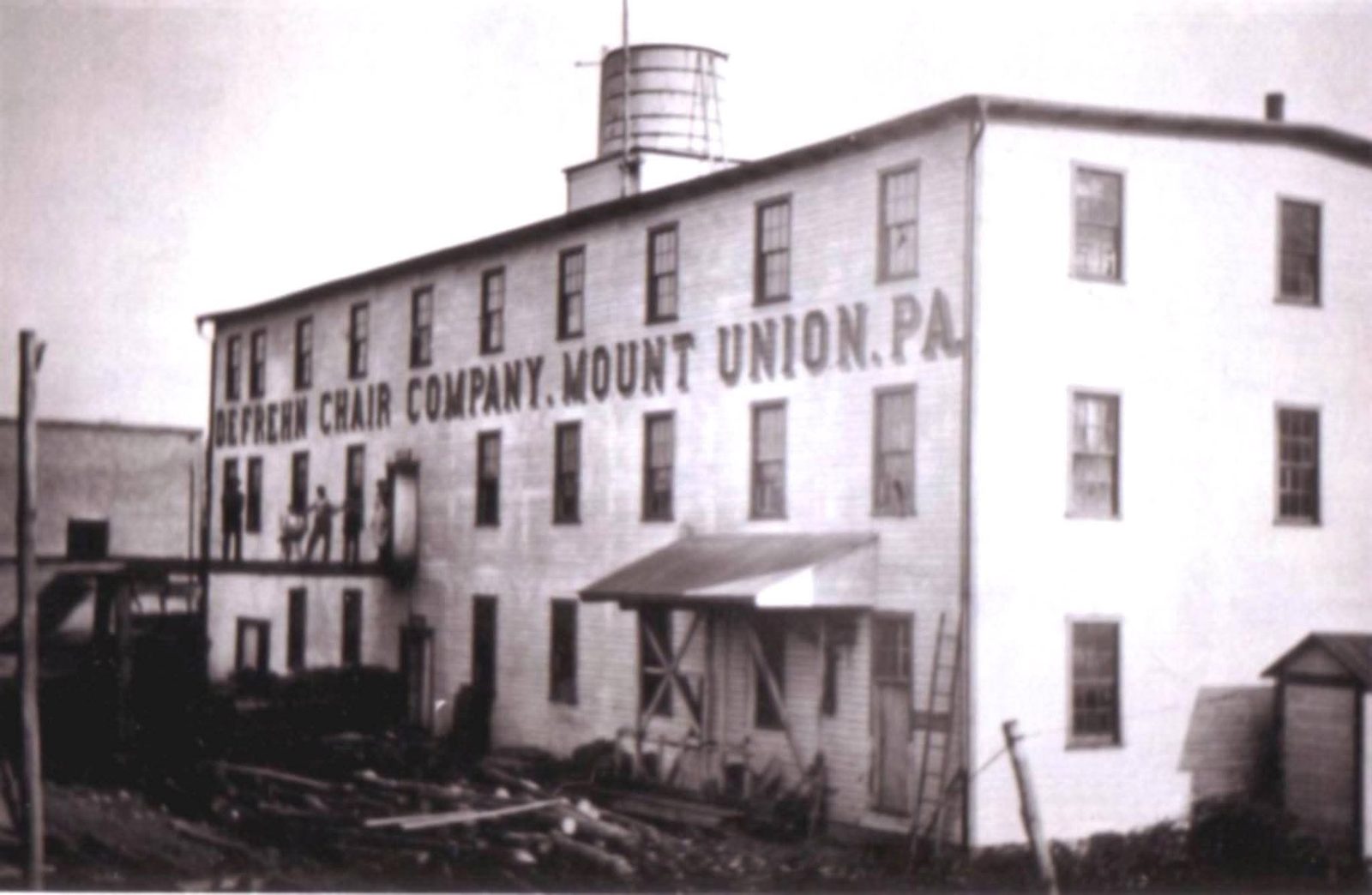
New finding, Aug 2026: this archive's only prior reference to the town's chair-making business was Welch's unnamed “Chair Factory built from a former tannery building” (1909-10, printed p. 380). A submitted photo, painted directly on the building's façade, identifies it as the “Defrehn Chair Company, Mount Union, Pa.” Whether this is the same building Welch described, a successor business, or an unrelated later operation hasn't been confirmed — the name is preserved here as new information rather than merged into Welch's account.
Sources
- Charles Howard Welch, History of Mount Union, Shirleysburg and Shirley Township (Mount Union, Pa.: Mount Union Times Office, 1909-1910), printed pp. 307–397. Page citations above refer to this book's original printed page numbers.
- J. Simpson Africa, History of Huntingdon and Blair Counties, Pennsylvania (Philadelphia: Louis H. Everts, 1883), PDF scan pp. 435, 441.
- Frederick L. Richards, “Mount Union Historic District” (National Register of Historic Places nomination, 1994), National Park Service.
- Jeff Britton, “Middle Division Main Line 279,” The Hobo's Guide to the Pennsy, pennsyrr.com — 1947 refractory-plant car-count figures cited above; see also the History page's 1906-07 viaduct and 1899-1972 timeline entries.